
15.3.2 มหาวิทยาลัยมีนโยบายในการจัดจำแนก ติดตาม และป้องกัน สิ่งมีชีวิตในบัญชีแดงของ IUCN และการอนุรักษ์รายการ สิ่งมีชีวิตระดับชาติ พร้อมนิสัยในถิ่นอาศัยโดยการปฏิบัติการในมหาวิทยาลัย
รายละเอียดโครงการ
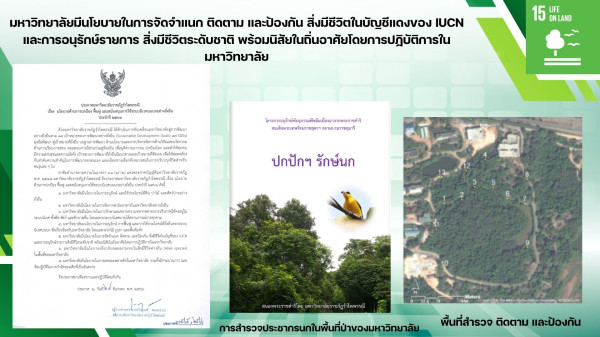
มหาวิทยาลัยมีนโยบายจัดจำแนก ติดตาม และป้องกันสิ่งมีชีวิตในบัญชีแดงของ IUCN และอนุรักษ์รายการสิ่งมีชีวิตระดับชาติ โดยการติดตามชนิดนกที่อาศัยในพื้นที่ของมหาวิทยาลัย จำแนกเป็นนกประจำถิ่น 54 ชนิด และนกอพยพ 22 ชนิด โดยพบสถานภาพความเสี่ยงต่ำ (Least Concern) รวมทั้งมีการติดตามพฤติกรรมสัตว์เลื้อยคลานใกล้แหล่งน้ำ ได้เเก่ เต่าหับ (Cuora amboinensis) มีสถานภาพใกล้สูญพันธุ์อย่างยิ่ง (Critically Endangered) สำหรับลั้ง (Physignathus cocincinus) มีพฤติกรรมวางไข่บนบกที่มีพื้นเป็นทราย จึงได้มีการอนุรักษ์พื้นที่สำหรับวางไข่เอาไว้ ลั้งถูกจัดอยู่ในสถานภาพมีแนวโน้มใกล้สูญพันธุ์ (Vulnerable) นอกจากนี้ยังพบว่านก เต่าหับ และลั้งเป็นสัตว์ป่าคุ้มครองตามพระราชบัญญัติสงวนและคุ้มครองสัตว์ป่า พ.ศ. 2535 อีกทั้งมหาวิทยาลัยยังมีห้องปฏิบัติการเพาะเลี้ยงเนื้อเยื่อพืช ทำการขยายพันธุ์กล้วยไม้ในสภาพปลอดเชื้อ เช่น กล้วยไม้เอื้องสายน้ำนม (Dendrobium cretaceum) จัดอยู่ในสถานภาพใกล้สูญพันธุ์ (Endangered) สำหรับกล้วยไม้เอื้องคำ (D. chrysotoxum) และกล้วยไม้เหลืองจันทบูร (D. friedericksianum) จัดอยู่ในสถานภาพมีแนวโน้มใกล้สูญพันธุ์ (Vulnerable)
The university implemented policies to classify, monitor, and protect species listed on the IUCN Red List and in the national conservation registry. Bird surveys conducted within the university area recorded 54 resident and 22 migratory species, most of which were classified as Least Concern. Monitoring of reptile behavior near water sources identified the Southeast Asian box turtle (Cuora amboinensis), categorized as Critically Endangered, and the Chinese water dragon (Physignathus cocincinus), which laid eggs on sandy soil, leading to the conservation of nesting areas. The water dragon was classified as Vulnerable. These species—birds, turtles, and water dragons—were also protected under the Wildlife Preservation and Protection Act, B.E. 2535 (1992). In addition, the university’s plant tissue culture laboratory propagated orchids under sterile conditions, including Dendrobium cretaceum (Endangered), Dendrobium chrysotoxum, and Dendrobium friedericksianum (Vulnerable), as part of its plant conservation and academic service efforts.
ภาพกิจกรรม
ลิงก์ที่เกี่ยวข้อง
ไฟล์ที่แนบ
SDG ที่เกี่ยวข้อง
 SDG 15 : การใช้ประโยชน์จากระบบนิเวศทางบก